
The $20,000 Watch
How one trader turned $70,000 into $7 million, and why the real lesson has nothing to do with crypto
$49.99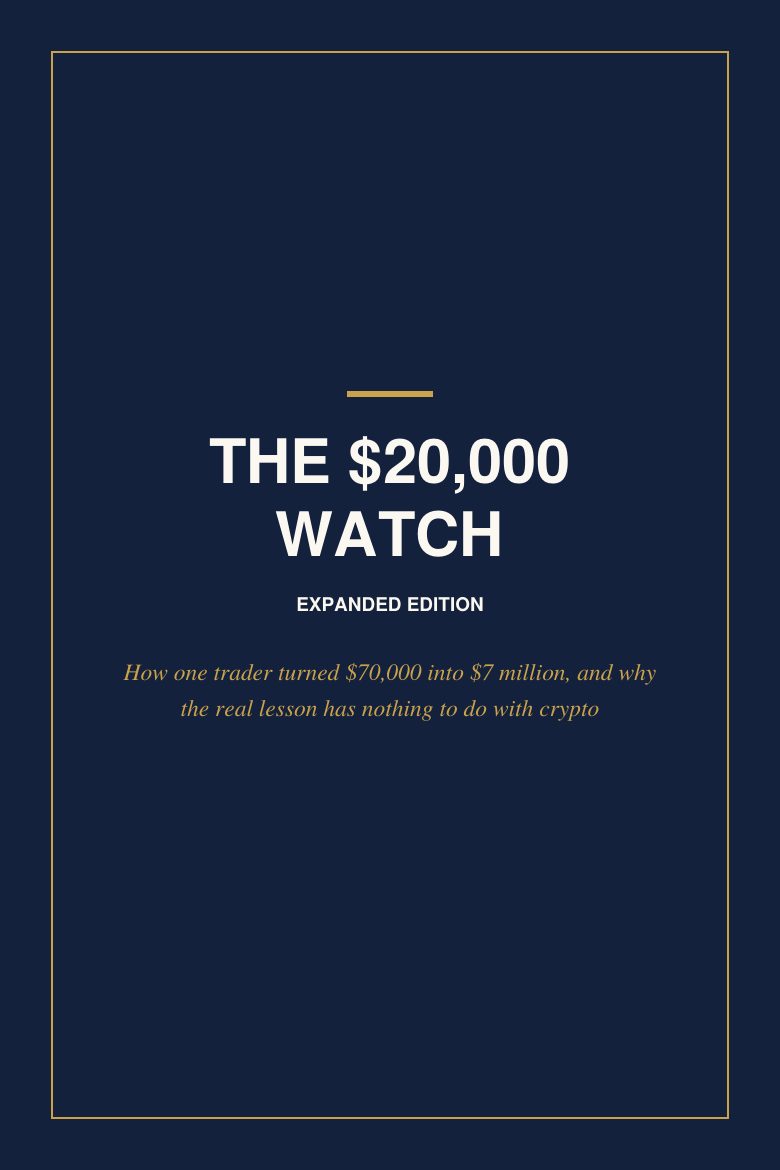
Lottery winners win once.
And then there’s a guy on the internet who won it three times. Not over a lifetime. Over twelve months. Public wallets. Timestamped entries. Three separate assets, three separate calls, and the receipts are all still up.
He does not predict prices. He predicts what people will want before they know they want it.
Who this is for
The everyday person
No charts, no coins, no risk tolerance required.
The day trader and crypto trader
The method behind the calls, put in order.
The person starting a business who is afraid of risk
Size the bet so a loss is a lesson, not a funeral.
What’s inside
- The $20,000 Watch
- Three Lottery Tickets
- The Arithmetic of Desire
- Front-Running the Future
- The Game of Reading People
- There Are Only So Many Slots
- The Pattern Nobody Talks About
- The Honest Parts
- The Mind
- The Exit
- The Operating System
- Protecting What You Make
- The Mind Under Pressure
- Read This With Caveats
- The One Skill
Bonus: The Utility Pack
The application layer. Three tracks, same core, backed by research.
- 15 practical tips
- Track 1: The everyday person
- Track 2: The day trader and crypto trader
- Track 3: The person starting a business
- The Buffett mirror
- Quotes worth keeping
- The Archive: most-watched videos, tap to watch
I’m not hoping and praying. I just know my numbers.
Get your copy
The $20,000 Watch
$49.99- Full Expanded Edition (PDF, 48 pages)
- The Utility Pack included
- Instant download
$49.99 seems expensive? Well, not every knowledge is for everyone
What readers are saying
“I bought this expecting the usual crypto hype. The sample alone made me put my phone down and stare at the wall. The lottery ticket comparison is not clever marketing. It's the actual thesis.”
“Never heard of this guy before a friend sent me the free sample. Read it on a flight and ended up buying the full thing before we landed. The opening of the ebook does something most trading books don't: it makes you interested in the person before the method.”
“The 'he predicts what people will want before they know they want it' line applies directly to my product launches. Bought it for the crypto, stayed for the demand forecasting.”
“I've read maybe thirty trading books. Most of them could be a blog post. The free sample is a few pages and it already did more work than half those books. The idea that lottery winners win once and this guy won three times is not a brag. It's a puzzle. And the ebook actually solves it. That's rare.”
“Forty-nine bucks for an opening that changed how I look at every market? I've paid more for worse coffee.”
“Downloaded the free sample out of curiosity. The opening is the reason I bought the full ebook. It sets up the whole thing without giving away the mechanics.”
“The idea that price creates perception creates demand is basic behavioral econ, but the way it's framed here made me rethink my own spending.”
“I'm 19 and never bought a coin. The intro still hit. It's about wanting things because they got expensive. I do that.”
“To me this ebook is worth $400. Not because of the dollar signs in the story, but because it reframes attention as the actual asset. That reframe alone paid for itself in how I think about my career.”
“Not everyone will get value from this. If you're looking for entry signals or a coin to buy, you'll hate it. The ebook is about a way of seeing, not a trade. For the right reader, that's worth $4,000. For the wrong one, it's not worth $4.99. That's not a flaw. That's how knowledge works.”
“I followed him for a year and still thought this was a memecoin book. The opening section corrected me in two pages.”
“I came in with zero context. The ebook's framing explains who this is and why the results are receipts, not the point. Good framing for a skeptical reader.”
“The line about watching the results and skipping the reasoning hit hard. I do that with everyone I follow.”
“I can't believe I spent $49.99 for an eBook”
“The opening is where I realized this wasn't a get-rich book. It's a method book. That distinction is why I'd pay $400 for it.”
“The sample ends early, but the framing alone made me want the full thing. It sets expectations honestly.”
“Some people need the results to be impressed. Some people need the reasoning. This resource assumes you're the second type. If you're the first, save your money. The book is priced at $49.99 because that's the basic price for people who already know what they're looking for. It's not a mass-market product. It's a filter.”
“The idea that you've been watching a demand forecaster, not a trader, is the kind of reframe that changes how you watch everyone.”
“I sent the opening section to three friends. Two bought the book. One said it sounded like a scam. That ratio is about right for anything worth reading.”
“Second time through, the framing hit harder. The first time I was looking for calls. The second time I was looking for method.”
“The watch metaphor is the entire resource in one page. Everything else is application.”
“I don't care about watches or crypto. But the idea that price changes desire, not quality, is something I see every day in my industry.”
“Same metal, same hands, same ticking. That's my product. The only thing that changed was the price. This part of the ebook explained my own market to me.”
“I'd pay $4,000 for this section alone. I'm not exaggerating. I run a small business and I've been pricing wrong for years because I thought value was intrinsic. The watch example rewired that. Price creates perception. Perception creates demand. Demand creates price. I wrote it on a sticky note and put it on my monitor.”
“The loop is real. I'm in it. Most people are.”
“This is where the free sample ends. Smart place to cut it. You get the thesis but not the method. Enough to know if you want the full thing.”
“Basic price, basic idea. But most people never get it. That's the gap this book sells into.”
“Bought the right house in the wrong-looking neighborhood. That's me. This ebook explained why it worked.”
“I thought the watch thing was a gimmick. Then I caught myself wanting a pair of sneakers because they'd gotten expensive. The ebook is right. I hate that it's right.”
“I read this part out loud to my wife. She's not a trader, doesn't care about crypto, and she said 'that's just people.' That's the point. The watch isn't about watches. It's about why we want what we want. I've shared this section with four people since. Three of them bought the book. The fourth said he already knew it. He didn't.”
“Three wins in one year, all public. I checked the receipts. They're real. That's the part that made me keep reading.”
“The first major call at a $2M market cap is the one that got me. I was there. I didn't buy. Reading this made me realize I was watching the right thing and doing the wrong thing.”
“I had to look up half these coins. But the point isn't the coins. It's that the entries were timestamped before the moves.”
“Three lottery tickets. I've had two in my career. This part of the ebook made me realize I was early both times and didn't know it.”
“The lottery ticket quote is worth $400 to me. 'You'll only win the lottery once in your life. So why did I win three times this year?' I've been thinking about that for a week. The answer is in the rest of the ebook, but the question alone is worth the price.”
“I bought the full book after the free sample. This section is why. The receipts are the difference between a guru and a method.”
“Not everyone needs the receipts. Some people just want the rules. But if you're the type who needs proof before you pay attention, this ebook is for you. The $49.99 is a basic price for people who know they need that kind of evidence.”
“The comment 'nobody uses that blockchain' saved and shown on camera. That's the confidence of someone who did the work.”
“Sent this section to a friend who's been in crypto for years. He said 'I remember when he posted that.' Then he bought the book.”
“The 38 days flat is the detail I missed the first time. That's the real story.”
“This is the part that made me stop treating this as a crypto book. The math is simple. 200,000 impressions a day. 1% buy. 600,000 buyers. 13,000 holders. The gap is the trade. I've applied this to three decisions since reading it, none of them crypto. It works.”
“The bathtub and fire hydrant image. That's what I needed. I'm not a numbers person. This section made the numbers feel obvious.”
“I don't know what an LP pool is. I still followed the math. That's good writing.”
“To me this ebook is worth $4,000. I'm a product manager. I do rough arithmetic on demand every day. This resource gave me a better framework in 10 pages than my last two years of intuition.”
“The confidence is a spreadsheet line. That's the most useful sentence in the ebook.”
“Some people will read this and think 'too much math.' Those people shouldn't buy the book. The $49.99 is a basic price for people who want the arithmetic, not just the vibes.”
“The free sample ends before this section. If you're on the fence, this is the one to peek at. It's the proof of work.”
“He did the arithmetic before he needed the courage. I've been doing it after. That's the difference.”
“I'm not good at math. This made me want to be good at math.”
“Shared this section with my brother who runs a small e-commerce brand. He said it was the first crypto thing that didn't make him feel stupid. That's a compliment.”
“The dog story is the one I tell people when they ask why I bought the book. Five months early. Bought the cold thing. Sold the hot thing. Simple.”
“I've never bought a memecoin. I bought this book because of the dog story. It's not about crypto. It's about seeing what people will want before they want it.”
“I've been front-running the future in my industry for years without knowing what to call it. Now I have a name for it.”
“This section is worth $400. I'm a real estate agent. I buy the house nobody wants in the neighborhood everyone will want in two years. Same skill. Different surface. The dog example made me realize I've been doing it and I didn't know there was a method to it. Now I do.”
“Buy the cold thing. Sell the hot thing. I've been doing the opposite my whole life. That's why I'm reading this book.”
“Not everyone can wait five months. If you can't, don't buy this. The price is basic. The skill isn't.”
“The line 'I'm buying something that is not a hot topic, and I'm selling it when it is a very hot topic' is the kind of thing that sounds obvious until you try to do it.”
“Sent the dog story to my group chat. Three people replied 'that's just investing.' They're right. That's why they need the book.”
“The 38 boring days is the part that scares me. I don't know if I can do that.”
“Bought the full book after reading the free sample twice. This section is where the method clicked. Front-running the belief, not the price. That's the whole thing.”
“The NFT flipping challenge is the most practical section in the book. Small account. Real trades. The reluctance-as-data thing is genius.”
“I run a small business. The line 'your own hesitation is data' is something I've been doing unconsciously. Now I do it on purpose.”
“I don't care about NFTs. But the order book as a mood ring is a great way to think about any market.”
“He looked at himself and treated his hesitation as a signal. That's a level of self-awareness most people never get to.”
“The reluctance-as-data idea is worth $4,000 to me. I've been in sales for twelve years. I've always known when a deal was going to close based on my own hesitation to push. I just never had a name for it. Now I do. And I can teach it.”
“This section is for people who want to read people, not charts. If that's not you, skip it. The $49.99 is basic. The insight is for a specific kind of reader.”
“Shared the 'don't undercut the floor' idea with my team. It's about managing the psychology of the room, not just the price. That applies to way more than crypto.”
“I still don't believe in NFTs. But I believe in the method. That's enough.”
“The free sample didn't have this section. I bought the full book because the sample made me want to find out what else was in here.”
“The part where he says he actually likes the project and holds it on another wallet. That's the most honest thing in the book. He's flipping something he believes in because the challenge requires it. That's professional.”
“80% of money in the top 10. That's not a crypto rule. That's a life rule.”
“This ebook is worth $400. I'm a content creator. The 80% rule is why I focus on one platform instead of five. I knew it in my gut. Now I know it in my head. The 'a slot is taken' framing is the urgency I needed.”
“The top 10 rule applies to my industry exactly. I've been chasing the 14,000 unseated coins. That's why I'm tired.”
“I have no interest in memecoins. But the idea that attention is concentrated applies to careers, content, everything. Good section.”
“Not all knowledge is for everyone. This ebook is for people who can handle the idea that most things are trash. If you're still in the 'everything has potential' phase, you'll hate it. If you're past that, it's the clearest resource in the book. The $49.99 is the basic price for people who are ready.”
“The free sample cuts off before this part. I bought the full book because I wanted to know what the 'only so many slots' thing meant. Worth it.”
“The slots are finite. That's just life. But most people never act like it.”
“Top 10 neighborhoods. I've been saying this for years. Now I have a book to point to.”
“The line 'if you're confusing trash for gold, that's on you' is brutal and fair. I needed to hear it.”
“Not everyone needs this section. Some people are already good at filtering. I wasn't. This ebook fixed that.”
“Cross a billion, go to three billion. That's a base rate, not a prediction. I've been treating it like a prediction for years. That's why I lose.”
“This ebook is worth $4,000. I'm a statistics teacher. The base rate idea is the whole game. I've been teaching it for years and I've never seen it explained this clearly for a non-technical audience. The stacking of base rates is the part I'll steal for my own teaching.”
“I don't know what Book of Meme is. But the pattern is clear. Cross a billion, hit three billion. It's a number, not a feeling.”
“Base rates in business are everywhere. Most people ignore them. This resource explains why.”
“This is the section that separates the gamblers from the operators. If you're a gambler, don't buy this book. It won't help.”
“Shared this with a friend who trades stocks. He said 'this is just historical base rates.' Yes. That's the point.”
“Gambling is a feeling. A base rate is a number. I wrote that on a sticky note.”
“I've never thought about base rates before. Now I think about them all the time.”
“The four patterns pointing the same direction. Convergence, not prediction. That's the most mature thing I've read about trading in a long time.”
“The 38 days flat. The patience is the price of admission. That's the part I missed the first time.”
“The losses are public. That's rare. I trust a book that shows the -$139k trade next to the wins.”
“I've read a lot of trading books. This is the first one that told me not to copy the author. That's the reason I bought the full thing after the sample.”
“Boredom is the tax on conviction. I've been paying that tax for years without realizing it.”
“This section is the filter. If you want a guru, you'll be disappointed. If you want an honest operator, you're in the right place. Basic price. Basic honesty.”
“The borrowed-money disclosure changed my view of this whole space. A guru telling you not to use leverage is a different kind of person.”
“Sent this part to a friend who lost money following a call. He said 'where was this book two years ago.'”
“'None of these plays happened overnight.' The simplest sentence in the book and the hardest to believe.”
“I appreciate that he doesn't pretend to be perfect. It makes the rest of the book believable.”
“This section is worth $400 to me. It's the one that made me trust the rest of the book. A confident trader showing his losses is like a poker player showing his bluffs. That's the real game.”
“The subtler honesty is the part about rotating wins into things that went to zero. I've done that. It hurt to read.”
“This is the section I'll read the most. The 400-day victory reframe is the single most useful idea in the book for me. I've been looking for trades for years. I've been bad at not destroying them. Now I know the difference.”
“The identity hack is weird and it works. I don't have a hamster. But I have a character now.”
“Money has a purpose and it's not more money. That's the most adult thing in the book.”
“I didn't expect a crypto book to have a section on the one-vice rule. I needed it. I've been eating two croissants for months.”
“This part is for people who want to think better, not just trade better. If you want calls, skip it. The basic price gets you the whole method, not just the entries.”
“Attention equals money. I've been putting attention in the wrong places. That's on me.”
“Shared the 'being correct beats being liked' section with my team. It's the most honest thing I've read about the cost of conviction.”
“I don't believe in the hamster thing. But I believe in the idea behind it. Self-belief is easier when you externalize it.”
“The self-reliance section hit hard. I've been depending on other people's calls. That's why I'm not winning.”
“This ebook is worth $4,000. I'm a coach. I've been teaching people discipline for years. The 400-day victory is the best framework I've ever seen for the difference between strategy and execution. I'm using it with my clients next week.”
“Take initials off. Keep a moonbag. I've been doing neither. That's why I'm still working.”
“Most books spend all the pages on entries. This one spends them on exits. That's the sign of someone who's actually done it.”
“The exit rules are the reason I bought the book. Anyone can buy. Selling is the hard part.”
“This part is for people who have made money and kept none of it. If that's not you, it might not land. Basic price, real discipline.”
“This section is worth $400. I made a 20x in 2021 and turned it into a 2x by rotating into a coin that went to zero. The line 'a 20x rotated into -90% is only a 2x' made me put the ebook down and stare at the ceiling. I've been that person. Now I have the rule.”
“Sell into hype. I've been selling into fear and buying into hype. That's why I'm behind.”
“Sent the five exit rules to a friend who's holding a bag from $4M to $200k. He didn't reply. I think he's thinking about it.”
“The 'improve your life' rule is the one I needed. I've been trying to compound forever. I've been compounding nothing.”
“The free sample didn't have this. I bought the full book for this. It delivered.”
“The moonbag strategy is the most practical thing in the book. I've been all-in or all-out my whole life. That's not a strategy. That's a mood.”
“Sit on your hands. That's the whole section. I've been standing up too much.”
“Control your inputs. Sleep, lifting, food, sun. I run a business and I've been ignoring all of these. The ebook made me take a walk. Not a metaphor. An actual walk.”
“The operating system idea is what separates the method from the results. I bought the book for the system, not the story.”
“This part is for people who want a process, not a pick. If you're looking for a coin, this isn't for you. Basic price. Real system.”
“This ebook is worth $4,000 to me. I'm a productivity consultant. The 'boring middle' concept is the best explanation of compounding I've seen. The idea that the longer you stay down, the more money you make through your job to accumulate your top holds. That's the whole game.”
“Study the boring middle. I've been leaving the boring middle my whole life. That's why I'm not ahead.”
“Sent the 'keep your receipts' section to a friend. He's a lawyer. He said that's the most professional thing in the book.”
“The environment is a variable, not a given. I've been blaming my environment. That's on me.”
“I read the free sample and wasn't sure. I bought the full book for this section. The operating system is the reason I'm reading it a second time.”
“I still think some of this is obvious. But I wasn't doing it. So maybe it's not that obvious.”
“Max profit is the wrong goal. I've been chasing max profit and losing everything. The goal is whether the money improves your life.”
“This part is for people who have made money and lost it. If you haven't, it might not land. The basic price is for people who know they need the reminder.”
“Bank most of a big win and trade with a small slice. That's how I run my business now. I wish I'd read this years ago.”
“The $3k to $140k, set aside $130k, take shots with $10k structure is the most practical thing in the book. It's not a strategy. It's a life.”
“Sent this part to a friend who hit a big win and lost it all. He said the $50k pulled out beats the $4M round trip. That's the line.”
“This section is worth $400. I've been the person who rode a bag from $4M to $200k. I know what that feels like. The book is right. The money only matters if it improves your life.”
“The moonbag is the psychological trick I needed. I've been all or nothing. That's not a strategy.”
“I don't have $3k to turn into $140k. But the principle is the same. Bank most of it. Play with a small slice.”
“The second time through, this part is the one I underlined the most. Protecting what you make is the whole game.”
“Not everyone needs this section. Some people are already good at taking profits. I'm not. The $49.99 was basic for the reminder alone.”
“Being profitable is not the same as being skilled. That's the sentence that made me stop trading for a week.”
“Execution matters more than the pick. 10% about the play, 90% about you. I've been picking well and executing terribly. That's why I'm not where I want to be.”
“The psychology section is the one I didn't expect. I bought it for the trades. I'm staying for the mind.”
“This part is for people who've been humbled by the market. If you haven't, you will be. The basic price is for the humility.”
“This ebook is worth $4,000. I'm a therapist. The eleven rules for staying steady under pressure are better than most of what I've read in my own field. The 'validate yourself at the bottom' section is the one I'm sharing with clients.”
“Do not marry your bag. I've been married to three bags. All of them cheated.”
“Sent the 'hype is a signal' section to a friend. If you're among the last 10% to hear about something, you're donating. That's the line that got him.”
“Persistence compounds. I needed to hear that. I've been quitting too early.”
“Some of this is obvious. But I wasn't doing it. So it's not that obvious.”
“The one about learning from losses but not dwelling is the one I've been failing at. I dwell. I replay. I don't move. This part made me move.”
“This section is why I trust the book. The caveats are real. The self-reported gains are self-reported. The advice is educational, not financial. That's honesty.”
“I've never seen a trading book tell you not to take its advice at face value. That's the reason I bought the full thing after the sample.”
“Not all knowledge is for everyone. This resource says so explicitly. The basic price is for people who want the caveats, not just the calls.”
“The 'his rules are better than his results' line is the most honest thing in the book. I've been following people whose rules were worse than their results.”
“Some advice is dangerous. Only risk money you can afford to lose. That's the line I sent to my brother.”
“Shared this part with a friend who was about to take out a loan to trade. He didn't. That's worth more than $49.99.”
“I appreciate that he says if you think this is luck, you can think that. He's not asking to be believed.”
“The caveats hit harder the second time. The first time I skipped them. The second time I realized they're the most important part.”
“This ebook is worth $400 to me. I'm a consultant. I've seen too many people lose money following gurus. This book tells you not to. That's the differentiator.”
“The $49.99 is a basic price for people who want the caveats. If you want a promise, you'll hate this. If you want honesty, you're in the right place.”
“This section is the whole book in five pages. See what people will want before they know they want it. Be willing to be early, alone, and bored. I've read it three times. It's the only skill I care about now.”
“The watch is worth $100. Then it's worth $20,000. Nothing changed except what people believed. That's my new business model.”
“I bought the book for the crypto. I'm staying for the one skill. It applies to everything.”
“This part is for people who want a way of seeing, not a way of trading. If you want a way of trading, the book will disappoint you. The $49.99 is a basic price for a way of seeing.”
“Attention equals money. That's the whole equation. I've been paying attention to the wrong things.”
“Sent this section to my sister who's a teacher. She said it's the best thing she's read about why kids want what they want. It's not about crypto.”
“The next time the crowd says nobody cares, remember what that actually means. It might not be a warning. It might be the entry. That's the line I'm keeping.”
“To me this ebook is worth $4,000. It's the whole system in a few pages. The rest is just the method.”
“I don't believe in the coins. I believe in the skill. That's why I bought the book.”
“The one skill is the only thing I've kept from the book. Everything else is detail. This is the point.”
“The quotes section is the cheat sheet. I screenshotted it.”
“The 20x rotated into -90% is only a 2x. That's the quote I needed. I've been rotating and calling it progress.”
“I didn't know the quotes before I read the book. Now they're on my wall.”
“These quotes are worth the price of the book alone. For people who know what they're looking at. The basic price is for the reminder.”
“Don't let a memecoin become a religion. I've been religious about the wrong things.”
“Sent the moonbag quote to a friend. He said it was the most useful thing anyone had told him all year. It's one line.”
“Under promise, over deliver. I've been over promising my whole life.”
“I don't agree with all of them. But I agree with enough to keep the book.”
“The quotes hit harder after reading the sections. Context matters.”
“These quotes are worth $400. I've paid more for less wisdom. The basic price was a steal.”
“The utility pack is the reason I bought the full book. The three tracks make it applicable to everyone.”
“Track 3 is the one for me. The 38-day rule and the 400-day victory applied to my startup. I've been in the boring middle for a year. This made me stay.”
“I'm not a trader. I'm not a business owner. I'm an everyday person. Track 1 is for me. The cold thing filter is now my rule.”
“The utility pack is for people who want to apply the method, not just read it. If you want theory, skip it. The basic price gets you both.”
“The one-vice rule is the most practical thing in the book. Two negatives in a row is a new pattern. I've been doing that.”
“Sent Track 1 to my wife. She's not into crypto. She said the cold thing filter is something she's been doing naturally and now she has words for it.”
“The 20-30% rule is the one I'm keeping. I've been all-in on everything.”
“The utility pack is worth $4,000 to me. It's the application layer. The rest is the why. This is the how.”
“I still don't buy memecoins. But I buy the utility pack. That's the difference.”
“The Buffett mirror is the smartest thing in the book. Same discipline, different surface. That's the whole thesis in one comparison.”
“The archive is the receipt. I've watched three of the videos. They match the book.”
“I found the book first, then the archive. The videos are the proof. The book is the method. Together they're worth the price.”
“The archive is why I trust the book. Anyone can write a method. Not everyone can show the archive.”
“The archive is for people who want receipts. If you don't need them, skip it. The basic price is for the book. The archive is the bonus.”
“The free sample didn't have the archive. I bought the full book and found it. Worth it.”
“Sent the first major video to a friend. He watched it and bought the book. The archive is the best sales pitch.”
“I've watched half the videos. They're better than the book in some ways. The book is the summary. The videos are the story.”
“I don't need the archive. But I'm glad it's there. It makes the book feel like a real thing, not a PDF.”
“The archive is the part I keep coming back to. The book is the map. The archive is the territory.”
“The archive alone is worth $400. I've paid more for worse courses. The basic price is a steal.”
Read it? Leave a review
Questions
What format is it?
A 48-page PDF that works on phone, tablet and computer.
How do I receive it?
Instantly after payment, by download link and email.
Is this financial advice?
No. It is a story and a way of thinking. Nothing in it is a recommendation to buy or sell anything.